

Recycling Information and Reminders
Your recycling efforts at home can help improve and sustain our environment and contribute to making your community safe and clean.
The following information is to assist you to manage your waste and recycle efficiently.
- 10 Common Yellow Bin Contaminants 10 Common Yellow Bin Contaminants
- What Happens with Yellow Bin Materials? What Happens with Yellow Bin Materials?
- What can I put in my Yellow Bin? What can I put in my Yellow Bin?
- Single Use Plastic Items - BANNED Single Use Plastic Items - BANNED
Placing landfill and organic waste items in your yellow recycling bin can contaminate the valuable recycling materials that have been correctly placed in there.
And it’s not just your recycling that might become contaminated, it’s the materials from other households that are taken along with yours to the Materials Recovery Facility (MRF) for sorting.
If recyclable items become contaminated it becomes difficult for them to be recycled, and this might lead to them being sent to landfill – so it’s important to recycle right.
Here are 10 common contaminants to keep out of your yellow recycling bin:
1. Soft plastics
Soft plastics can cause many issues at the MRF, including getting tangled in machinery, preventing it from working effectively.
All soft plastics should be placed in your red lidded landfill bin only.
2. Nappies
Nappies are not recyclable, and in South Australia nappies must always be placed in your red lidded landfill bin.
3. Ropes, hoses, and strapping
At the MRF, these items can become entangled with other materials and with the sorting machinery itself, causing contamination and increasing the risk of mechanical breakdown.
Ropes, hoses and strapping that can no longer be used should be placed in your red lidded landfill bin.
4. Broken crockery and glassware
Ceramics that get mixed in with recyclable glass will weaken the product, so crockery like plates and mugs – broken or not – cannot be placed in your yellow recycling bin.
And while whole, unbroken glass bottles and jars can be placed in your yellow recycling bin, any broken glass cannot, as when it reaches the MRF it will continue to break into even smaller pieces of glass which are difficult to collect and can contaminate other recyclable materials like cardboard and paper by becoming embedded in them.
Broken crockery and glassware should be wrapped in something like newspaper and placed in your red lidded landfill bin.
5. Unwanted clothing, bedding, and other textiles
If the items are still in good, usable condition, donate them to your local charity store. Your local animal shelter may also accept donations of towels and blankets to be used as bedding.
If the items are not in good enough condition to be passed on to someone else, they should be placed in your red lidded landfill bin.
6. Expanded polystyrene
Expanded polystyrene (EPS), also known as Styrofoam, is used to produce items like meat trays and foam packaging.
Styrofoam can’t be recycled through your yellow recycling bin as it causes contamination by breaking up into many small pieces. At the MRF, it also gets caught up in the paper/cardboard stream.
Foam meat trays and any packaging foam you can’t drop at a recycling centre should be placed in your red lidded landfill bin.
7. Bagged recycling
Bagged recycling poses a safety risk for MRF employees as there may be harmful contaminants, like needles, inside the bag. As a result of this safety risk, all bagged recycling is sent to landfill.
Always place your recyclable items loosely in the bin so they can be sorted and recycled easily and safely.
8. Building materials
Building materials such as bricks, cement, tiles, wire and scrap metal damage trucks and machinery, and cannot be placed in your yellow recycling bin.
Instead, take these materials to your nearest transfer station for processing and recycling, but note there will be a cost involved in this.
9. Food and liquids
Foods and liquids placed in the yellow recycling bin cause a mess and can contaminate any recyclable materials in the bin.
Any containers and bottles should be emptied of food and rinsed off before they’re placed in the yellow recycling.
10. E-waste
Electronic waste or e-waste like TVs, phones, computers, and cables can be recycled – just not through your yellow recycling bin.
Household batteries can be dropped off for recycling at the North Shields Post Office, Coffin Bay Post Office, and Cummins Council office.
There are a number of specialised recycling centres equipped to handle e-waste. Council offers two waste transfer stations in Cummins and Coffin Bay that accept e-waste. Further details can be found here.
There are many apps and websites that can assist the community providing information on what can and can’t be recycled. Keep an eye out for future information regarding these.
Once collected from the kerbside, your yellow bin materials are taken to a Materials Recovery Facility (MRF), where they are recovered and sorted into secondary raw materials so they can be recycled into new products.
The MRF sorting process has 8 steps:
1. Pre-Sort Room
In the pre-sort room, MRF sorters manually remove as many contaminants as possible. Contaminants can include textiles, nappies, crockery, batteries, gas bottles and other items that are non-recyclable.
Large pieces of cardboard are also separated and moved onto conveyors to bypass the sorting equipment, helping it to work more efficiently. At the end of the sorting process, these large cardboard pieces are combined back with other cardboard products.
2. Trommel
From the pre-sort room, materials are moved into the trommel – a large cylinder that is lined with holes of 2 different sizes and rotates the materials around, separating containers (like glass bottles, steel cans, aluminium cans and rigid plastics) from paper.The separated containers then travel over bounce conveyors, which separates any residual paper from the stream.
3. Container Sorting Room
The separated containers then move on to the container sorting room, where different types of plastics and glass are separated into different holding bunkers, ready for a quality check by the MRF sort
4. Screening and Quality Check
The sorted plastic and glass container products are screened, quality checked and bulked up ready for transport to end markets to be recycled back into products.
5. Electro Magnet
An electro magnet is then used to remove steel cans, which are transferred to a steel baler and baled ready for transport to downstream processors to be made back into steel products.
6. Eddy Current
Next, an eddy current (a loop of electrical current) removes any aluminium products (such as drink cans, deodorant cans, aluminium trays and foil), and these are and blown into cages ready for a secondary sort into beer cans, soft drink cans and other aluminium products.
7. Ballistic Separators
Back to the paper stream, ballistic separators clean up the stream by separating any residual containers, glass, dirt, bottle tops and organics. From there, the paper is transferred to the quality sort paper room.
8. Quality Sort Paper Room
In the quality sort paper room, MRF sorters remove any contamination left in the paper and cardboard stream so it can be baled ready for transport and recycling back into paper and cardboard products.
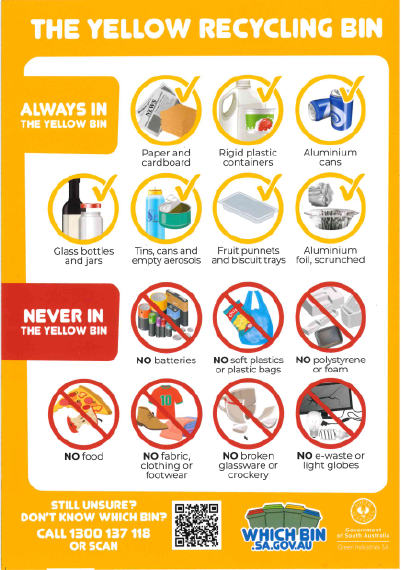
Council in conjunction with the waste contractor Veolia, would like to encourage non-recyclable bottles and glass to be taken to Recycling Depots such as Councils at the Waste Transfer Stations in Cummins and Coffins Bay.
While it is acceptable to put into the kerbside recycling bins; there is an increased risk of the glass breaking, making the co-mingled recycling difficult to sort and potentially causing contamination of other recyclable material placed in the bins.
For trading hours of the recycling depots, please refer to the Cummins Recyclers tab linked here Cummins Recyclers | Lower Eyre Council
From 1 September 2024, the following single use plastic products will be banned across South Australia:
Plastic barrier bags
Plastic bags without handles (known as either a 'produce bag' or 'barrier bag'), used to contain and protect unpackaged produce, nuts and confectionery will be banned. Learn more.
Thick supermarket or boutique-style plastic bags
Heavyweight film plastic shopping bags, plastic-laminated paper shopping bags and plastic-laminated cardboard shopping bags will be banned, with some temporary exemptions. Learn more.
Expanded polystyrene (EPS) consumer food and beverage containers
Expanded polystyrene cups, bowls, plates and clamshell containers were prohibited from sale, supply and distribution in South Australia on 1 March 2022. Other expanded polystyrene (EPS) consumer food and beverage containers in the market (including gelato tubs, cake boxes and meat and fruit trays) will be banned from 1 September 2024. Learn more.
Plastic confetti and plastic balloon sticks/ties
Plastic confetti designed or intended to be used for scattering, throwing, decorating or being released at celebrations/events, such as wedding ceremonies, parades, concerts, sporting events and parties will be banned, along with plastic balloon sticks and plastic balloon ties (including those sold in kits). Learn more.
Plastic food bag tags
Single-use tags, designed or intended to hold food product bags closed, including (but not limited to) bread bags, produce bags and rice cakes will be banned, with a temporary exemption until 31 August 2029 for plastic food bag tags used to hold closed a bag of potatoes or carrots weighing 2kg or more. Learn more.
Single-use plastic beverage containers (including coffee cups)
Single-use plastic beverage containers (including coffee cups) offer convenience for consumers, but these items and their attachments (such as lids and beverage plugs) have limited recovery and recycling pathways, creating confusion for consumers. These items will be banned, with some temporary exemptions. Learn more.
Single-use plastic food containers
Plastic food containers, including plastic-lined or aqueous coated containers, used for takeaway food prepared for sale and consumption on the same day, for example takeaway food containers, single-use plastic bowls with plastic lids,
single-use plastic trays with plastic lids, and single-use plastic cups with plastic lids used for food will be banned, with some temporary exemptions. Learn more.
Alternatives:
Click here for further information on reusable and compostable alternatives.